Award for Matshobotiyana’s thesis that included ‘red cotton’ and ‘feeling and ugly’

Decolonial literature scholar Yonwaba Matshobotiyana won the Africa Thesis Award at Leiden University. Dr Matshobotiyana’s (completed at the University of the Free State) is entitled e thesis ‘Of Speaking and Visibility: The Intersectional Resistance and Resilience of Black Women in Koleka Putuma’s Collective Amnesia, vangile gantsho’s red cotton and danai mupotsa’s feeling and ugly‘. We celebrate this award, and the deep engagement with these works, including two impepho press titles.

Source: Winner Africa Thesis Award 2025: Yonwaba Matshobotiyana https://www.ascleiden.nl/news/winner-africa-thesis-award-2025-yonwaba-matshobotiyana
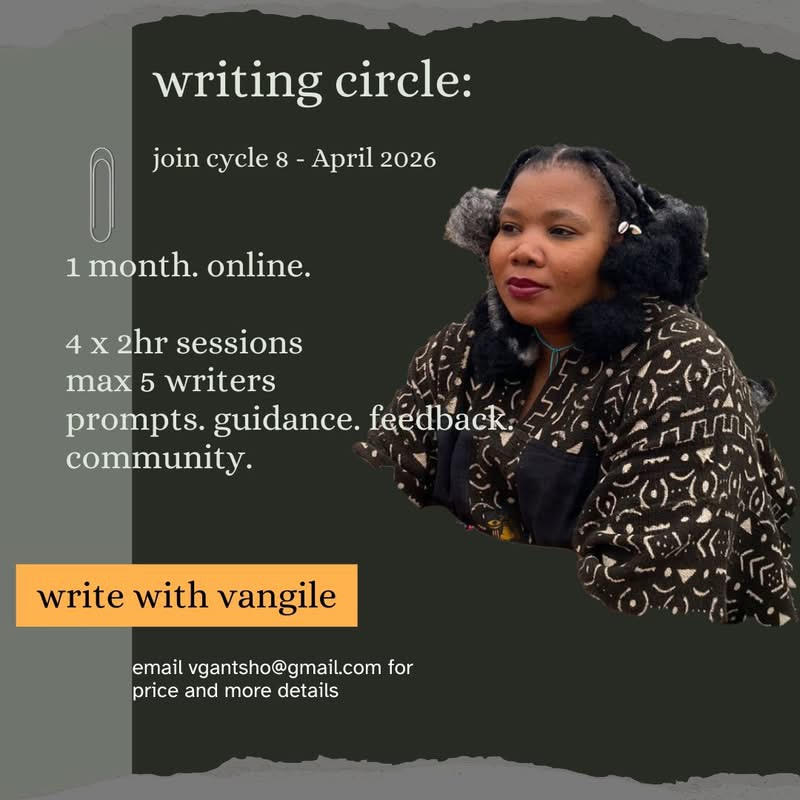
Interview with vangile gantsho on The Shallow Tales Review

TSTR: Eleven years ago, you published Undressing in Front of the Window. I see debut books like great teachers. They often leave enduring marks. I wonder now at your book’s maturation over the years, to what it has perhaps revealed to you.

vg: hahaha! eish. ja neh. this book reflects to me how hard i am on myself. i have abandoned her (the book) too many times. felt ashamed of her and forgotten to honour the woman i was when i crafted her. she teaches me that there is beauty everywhere. precious moments in rubble. that i care very deeply for people and about the world i live in. i have always been like this… it is a part of who i am. and the more i lean into that, the clearer the writing becomes.

this is not only the book i learned to write through. it’s also how i learned about publishing and building teams and trusting others with babies. she taught me about community in the isolated vastness of poetry.

Source: The Shallow Tales Review
Poetry as re-membering: in conversation with vangile gantsho,

Speaking with stars

Poet, cultural activist and healer Vangile Gantsho lets us into her home.

“Molweni. I’m Vangile Gantsho. Welcome,” she said.

We’ve discovered a different world with a cosy atmosphere and an intentional feel. The Black Power Station space was filled with lush plants, dimmed lighting, vintage art, comfy furniture, and an intriguing energy that offers a different kind of peace. It felt like being kwa makhulu – it embraced the nostalgia of a Black family under the guidance of a strong matriarch and was a safe space for growth and creativity.

Read the full story by Dideka Njemla (7 March 2025).

Source: Grocott’s Mail in PressReader

A journal article: Recasting slam poetry: Busisiwe Mahlangu’s début poetry collection Surviving Loss

Translated from Italian by Google Translate: The relationship between orality and writing in Africa has generated wide-ranging debates. However, there are no significant studies on the transition from slam poetry stages to printed books. Analyzing the problems inherent in the process of translating oral performances into written texts, Scheub (2021) argues that translators must reconceptualise original works, creating completely new works: that is, they must reformulate them. Based on this theoretical principle, this article examines Busisiwe Mahlangu’s evolution from slam poetry champion to print poet, analyzing her debut work, Surviving Loss.

Source: D’Abdon, R. (2024). Recasting slam poetry: Busisiwe Mahlangu’s début poetry collection ‘Surviving Loss’. Le Simplegadi, (24), 103–115, DOI: 10.17456/simple-229. Forum Editrice Universitaria Uninese.

Publishing in Sub-Saharan Africa Grows Amid Inflation, Piracy

By Anietie Isong | Nov 27, 2024

In early 2024, the British Council commissioned a study, Publishing Futures: A Study of the Publishing Landscapes in Ghana, Kenya, Nigeria, South Africa, Uganda, and Zimbabwe, focused on the publishing landscape in African countries where the council operates. Findings from the research indicate that there are several successful trade publishing houses owned and managed by Africans. Some of these include amaBooks, Cassava Republic, impepho press, Inkani Books, Jacana Media, Masobe Books, Modjaji, Narrative Landscape Press, Noirledge, Ouida, Sevhage, and uhlanga, among others. This is a shift from the 1990s, when multinational publishing corporations and educational publishers dominated the market.

Source: Publisher’s Weekly